
The day when the corporate world reaches its year-end performance bonuses. Nevertheless, the financial experts are warning against a dangerous trap that people often fall into: the integration of variable pay into one’s fixed lifestyle costs. The lingering effects of treating a one-off bonus as part of a monthly salary give birth to what is called “financial fragility,” which, in turn, makes your future security solely dependent on uncontrollable factors.
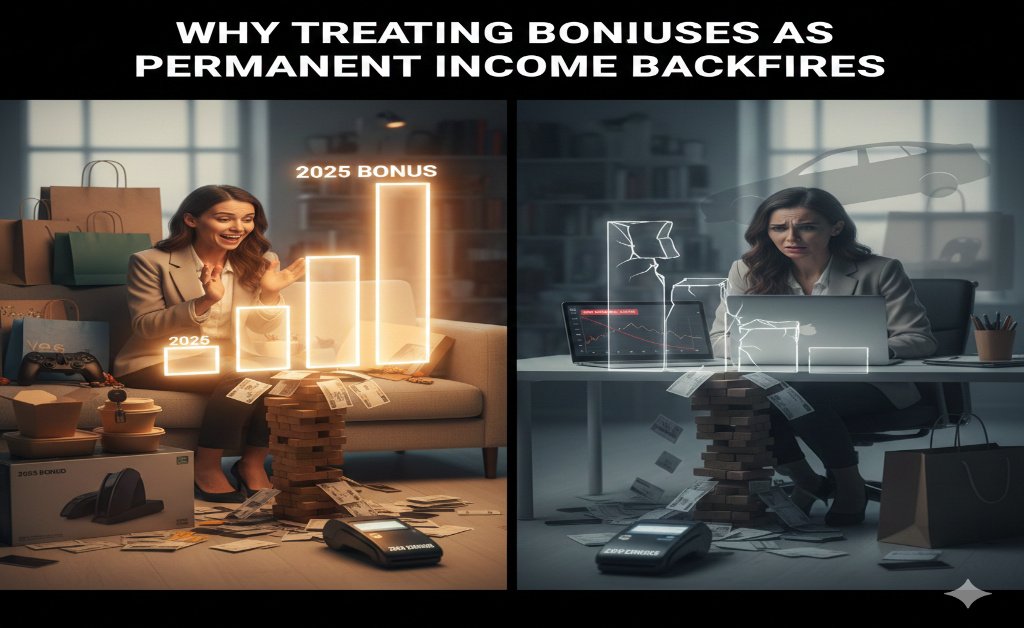
Turning Variable Cash to Fixed Stress – The Major Risk
The foremost risk is the changeover from flexible, uncertain income to inflexible monthly obligations. Many high-income professionals are caught in the trap of lifestyle upgradingthe move to a higher-cost apartment, the signing of a premium car EMI, or the increasing of monthly SIPsright after the arrival of a bonus. By locking in these costs, you are wagering that the next year’s revenue and performance will be the same or better. With the year 2026 drawing close, market turbulence continues to be a prevailing reality. Hence, in case the bonus is cut or not paid at all, those so-called “permanent” expenses will still exist, leaving the individuals often no choice but to utilize their emergency funds or go for a loan to cover the gap.
Financial flexibility and growth can still be slowly but surely eroded
Traditionally, bonuses have been used for the purpose of wealth, but not for daily subsistence. The moment that you decide to spend a windfall purely on upgrading your lifestyle, you completely miss out on the chance to reinforce your financial foundation. Paying off the debt with variable income or completely funding an emergency reserve are both ways to permanently decrease your financial anxiety. However, using it to support a repeating luxury will just make your “hedonic treadmill” bigger, thus making you happier at a higher level without your wealth really increasing. Professionals recommend treating variable income as a source for flexibility, whereas stable income should be considered a fund for obligations.
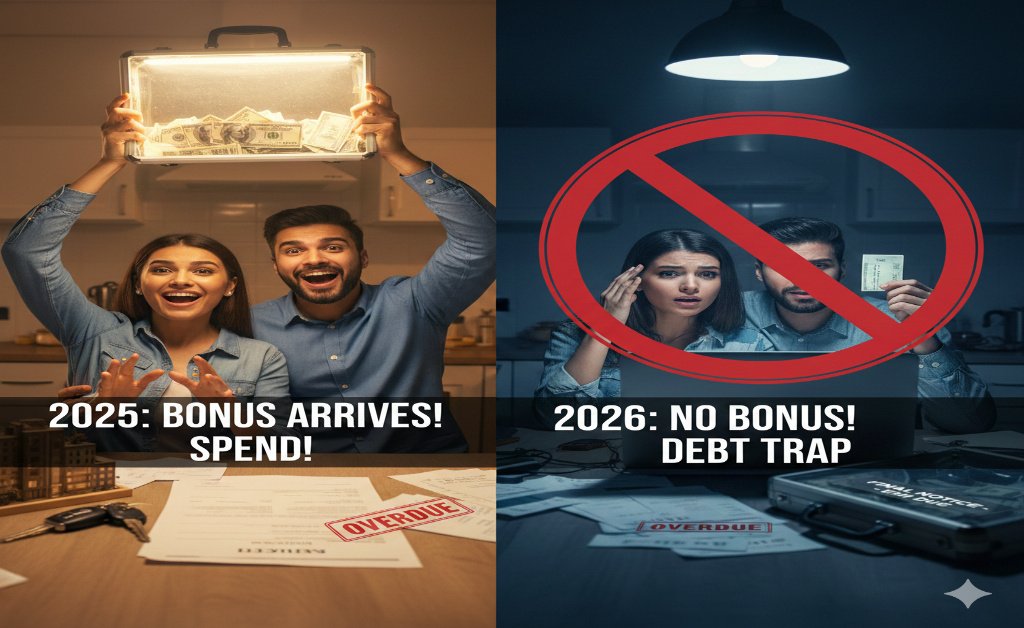
A strategic outlook for 2026 and beyond
To protect your finances in the coming year, consider the “Margin of Freedom” method, whereby you keep your fixed lifestyle far below your total income. Instead of simultaneously advancing the economy and your lifestyle, use the 2025 bonus cycle to gain additional time. An increase in your savings plus a doubled-up buffer will enable you to ride out the unexpected shiftssuch as job changes or industry downturnswithout the silent stress of being over-leveraged. When bonuses are treated as tools for one-off goals or as investments made in the form of lump-sum payments, you make sure that the rewards of your hard work will not only be long-lasting but also liberating instead of pressurizing.