
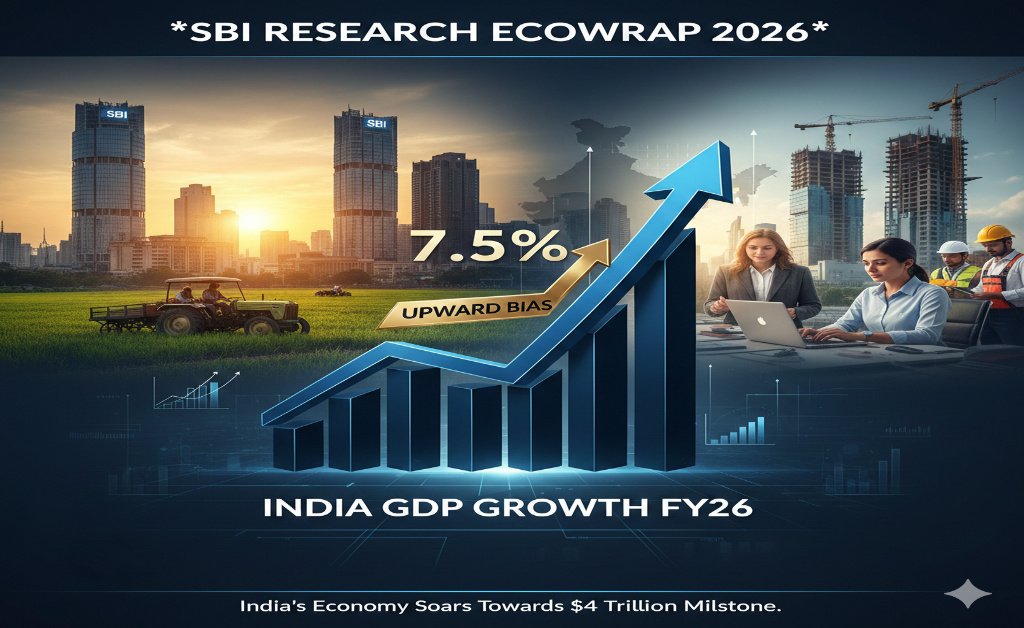
The latest Ecowrap report released on January 7, 2026, from the State Bank of India (SBI) Research team predicts India’s Real GDP growth for the financial year 2025–26 (FY26) at 7.5%. The forecast sounds even better, as India’s earlier estimates were thought to be too optimistic, thus placing India among the few resilient nations to lead the global economic environment even in such a scenario.
Acceleration of Real GDP Growth
The SBI report considers the impact of economic fluctuations in the world, saying India’s economic momentum is “largely domestic-driven,” and thus, it can still cope with the external headwinds. While the National Statistical Office (NSO) recently estimated growth at 7.4% and the Reserve Bank of India (RBI) gave a forecast of 7.3%, the SBI economists are confident that the actual number will be closer to 7.5%. One of the main reasons for this optimism is a rebound in Capital Formation, which witnessed real growth of 7.8%up by 70 basis points from the previous year, i.e. a very strong revival in investment demand.
Strategic Impact of Base Year Revision
A crucial topic in the report is the impending change in the GDP base year from 2011–12 to 2022–23. SBI Research expects that this technical adjustment, which is announced to be of February 27, 2026, will reveal the structural changes in the economy more accurately and, thus, lead to an increase in the bias of existing figures, probably even allowing nominal GDP to reach around ₹357 lakh crore ($4.1 trillion) by the end of March 2026.
The Services Sector as the Main Engine
The Services Sector is not only holding the top position but also leading the pack, with a forecasted growth rate of 9.1% for FY26. Despite the agriculture sector undergoing a slight decline, the report points out that “traction in services” and vigorous government expenditure (up 5.2%) have supported overall demand significantly. In addition, the increase in the per capita national income has been quite considerable, projected to be ₹2,47,487 per annum, which is an indication of the extensive penetration of India’s economic growth.

Holding a Fiscal Deficit at a Stable Level
The report talks about the Macro Economic Scenario and the Fiscal Deficit, which it forecasts to stay at 4.4% of GDP unchanged. Tax revenues are likely to be slightly under the budgeted targets, but the difference will be counterbalanced by higher-than-expected non-tax revenue. This fiscal discipline, coupled with a shrinking gap between real and nominal GDP, strengthens the already stable banking and financial landscape as India nears the $5 trillion landmark.