
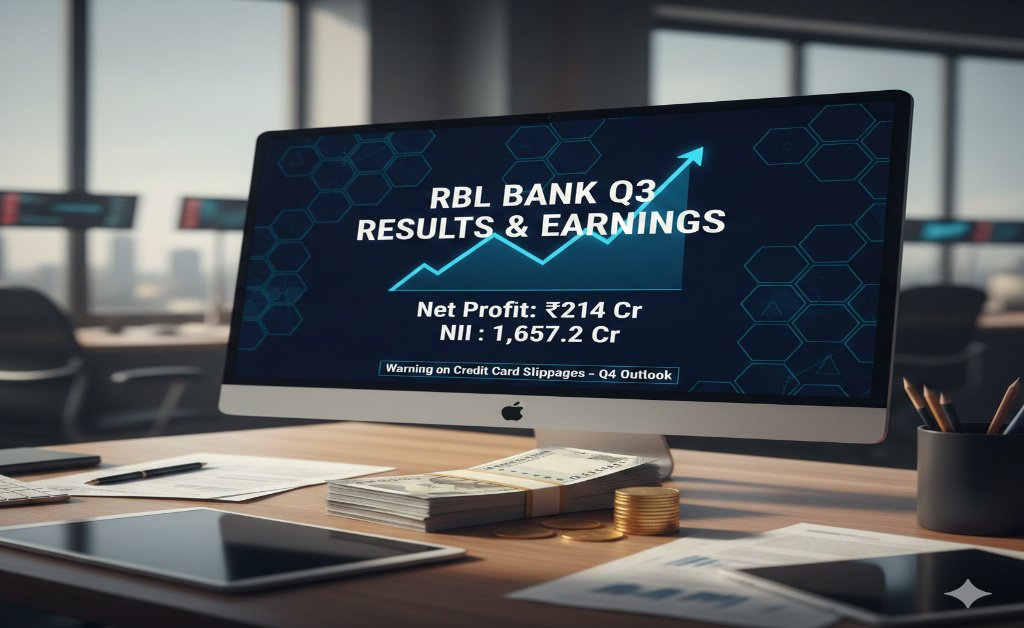
The private bank’s net profit for the quarter that ended in December 2025, stood at ₹214 crore. This number, although it fell short of some market forecasts, was very much a big jump from the low base of ₹33 crore set a year back. Net Interest Income (NII) was able to rise by 4.6% going by the year-on-year comparison and thus, it reached ₹1,657.2 crore. There was wholesale and commercial loan segment growth that was the main reason for the income increase. The condition of the bank’s assets improved as Gross NPA came down to 1.88% from 2.32% in the quarter before indicating the bank was indeed focused on cleaning up its balance sheet.
Warning on Credit Card Slippages
The management, however, even with all profit growth, gave a wary Warning on Credit Card Slippages, and it then went on to clarify that the situation in the credit card portfolio would not improve for two more quarters. The bank has been facing “high slippages” that arise mostly from older loan vintages and more general macroeconomic issues affecting the unsecured loan segment the hardest. RBL Bank’s unsecured loans account for about 26% of its total advances and the bank aims to reduce it to 25% or lower by the end of the fiscal year to cope with the risk better.

Doubling Down on Gold Loans
The bank is making the initiative of Doubling Down on Gold Loans as its core growth engine to rebalance its portfolio toward safer, collateral-backed assets. Gold loans by branches have disbursed a considerable sum of ₹225-250 crore a month. Gold loans are a segment that management sees as the bank’s strong point since the loans that are secured by the bank’s network of branches are easy to increase in number. Hefty margins will be the result of this Strategic Pivot toward retail secured products and thus the bank will cut down the credit costs with the bank’s targeted Net Interest Margin (NIM) of 4.75–4.80% by March 2026 as the portfolio mix shifts.