
Banking Sector Liquidity Injections
The Reserve Bank of India (RBI) has communicated an entire liquidity stimulus package of almost ₹3 trillion. It includes the huge ₹2 lakh crores infusion in Open Market Operations (OMO), which is to be carried out in four phases of ₹50,000 crore each starting from December 29, 2025. Besides this, there is a $10 billion USD/INR buy-sell swap auction, which is meant to alleviate the rupee liquidity crunch that was caused by the recent interventions in the currency market. These systemic measures are necessary for the commercial banks that are currently experiencing high credit demand and tight cash conditions due to advance tax outflows, allowing the interbank lending market to remain stable as the new year draws near.
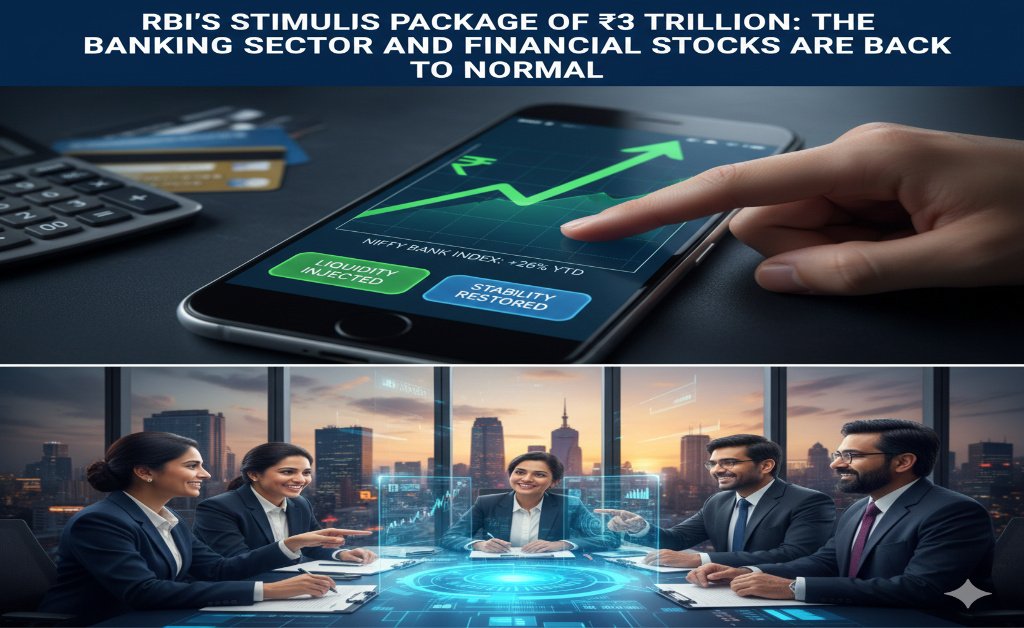
Banking Stock Performance and Analysis
The stock market is revealing a strong but careful trend in banking shares. The Nifty Bank index has positioned itself at around 59,300, which is the support line and is the result of the renewed interest in the big private lenders such as HDFC Bank and ICICI Bank. The market’s confidence has been further enhanced by the Competition Commission of India (CCI) giving the green light to Blackstone’s purchase of a 9.99% stake in Federal Bank, which is a sign of strong global trust in India’s mid-sized lenders. However, there was only selective buying of private banks, while the Nifty PSU Bank Index has been the best winner in 2025, with an over 26% rise thus far, benefiting state-owned banks, which have much better balance sheets and cheaper valuations compared to their private peers.

Financial Services and Credit Trends
The larger financial services industry is going through a revolution in credit distribution. Fresh statistics point to a conscious and gradual shrinking of unsecured lending, where new credit card issues have gone down considerably year-on-year as banks focus on asset quality. On the other hand, secured lending in the housing and auto sectors is still strong, a nd the State Bank of India (SBI) is retaining its leadership position. Credit trends are followed very closely by the investors, as the RBI’s “ample liquidity” policy acts as a buffer that enables the banks to keep growing their loans by double-digit percentages, while deposit growth is only in the single digits.