
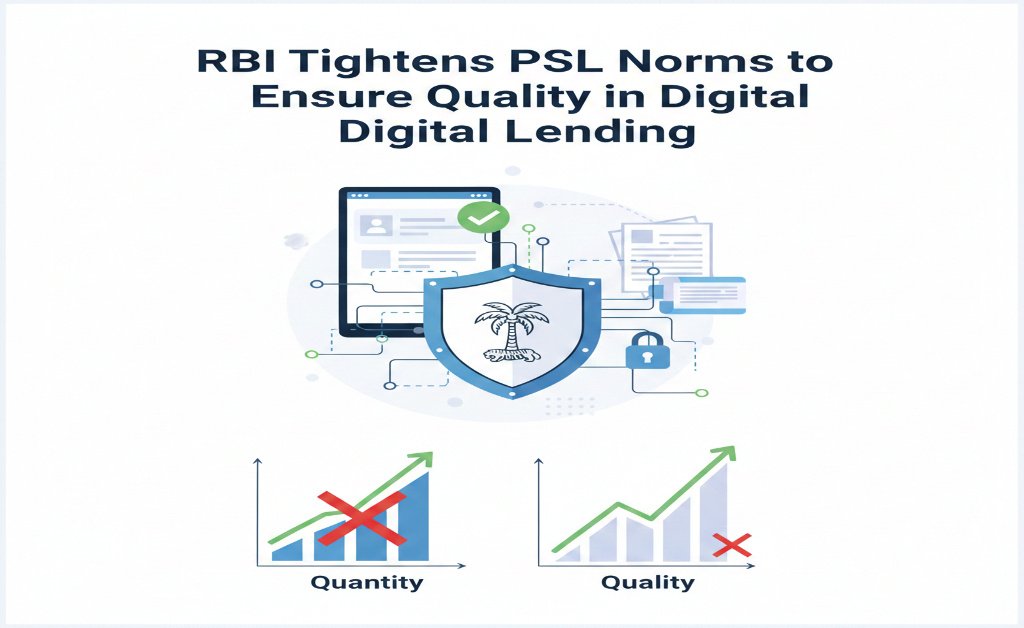
The Reserve Bank of India (RBI) is imposing stricter regulations on Priority Sector Lending (PSL) which will fundamentally change the lending practices of banks and other financial institutions. Those regulatory changes are meant to prevent misreporting and at the same time make sure that credit really goes to the definitely underserved areas that were aimed at.
Enhancing Underwriting Standards with RBI PSL Norms
According to the new paradigm, lenders working as, intermediaries, such as, NBFCs and microfinance institutions are obliged to get external auditor certifications. Having such a certification will ensure that loan amounts tagged under PSL categories are genuine and will not be counted again in other institutions. The RBI is making a rigorous position-to-volume movement by the demand for very high data integrity and end-use verification, thus moving from an aggressive volume goal to a strong underwriting discipline.
Shifting Focus to Quality in Digital Credit
Digital lenders and NRFBs that are fintech-partnered, who in the past put more weight on speed and minimal friction, are now under more pressure to improve their models for risk assessment. The new regulations are mainly directed at these lenders, telling them to take care of borrower quality and accurate loan classification rather than just focusing on the number of disbursements and not to forget that the rapid expansion of digital credit is going to be sustainable, because it is going to be through safe channels only.

Impact of Regulatory Compliance on Banking Strategy
Regulatory reviews of recent times have made public the state of poor compliance of PSL (Priority Sector Lending) at top private banks which has resulted in a huge sum of money being set aside for additional provisioning. This strictness prescribes that the regulator will not bear the misclassification of loans any longer to reach the targets. As a result, banks are now employing high-tech digital verification and monitoring tools to follow through on the funds’ end-use and are thus, paving the way for their lending strategies to be based on long-term asset quality rather than short-term growth metrics.