
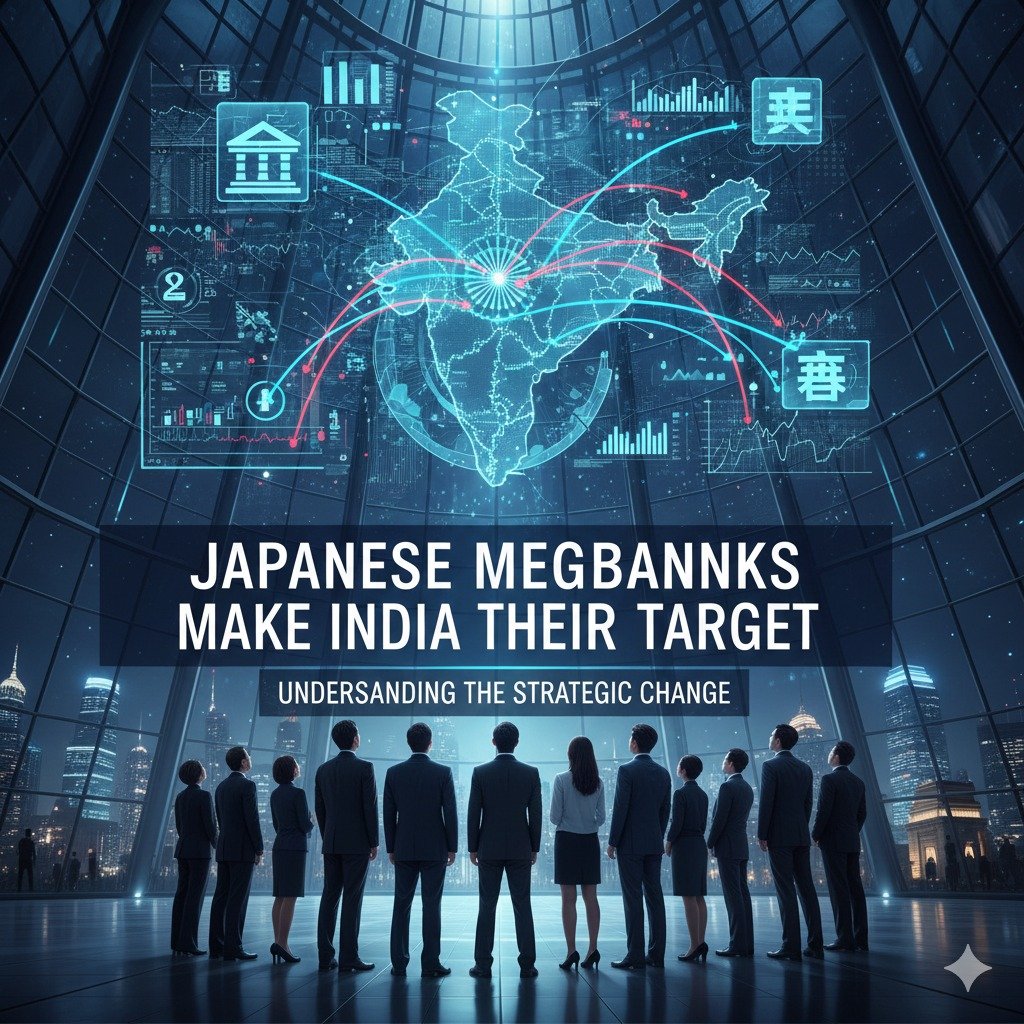
The Indian banking scene is getting a historic deal of investments from Japan’s “Big Three” financial giants MUFG, Sumitomo Mitsui (SMBC), and Mizuho. This trend continued up to December 2025, when MUFG invested ₹39,618 crore ($4.4 billion) in Shriram Finance, which was the largest amount of foreign direct investment (FDI) India had ever seen in the financial services sector, marking the turning point of this trend. This bold and aggressive moveis deep-rootedd in the difference between Japan’s stagnant market and India’s lively credit system.
1.Get Away from Home Stagnation
The Japanese banks’ ordeal lasted over twenty years, during which time the market was adult ithe a sense that it had nearly zero interest rates, a small number of workers, and an aging population. The Bank of Japan has just increased its interest rate to 0.75%, but still, the structural constraints are quite heavy. On the contrary, India has a youthful population, a burgeoning middle class with increasing incomes, and a good GDP growth rate of 7.3% that has been forecasted for the financial year 26, making it the place where Japanese banks can get the “yield” and the oexpansion opportunitiesthey cannot find in their market anymore.
2.Going into Shadow Banking (NBFCs)
The focus has shifted from traditional corporate lending to India’s Non-Banking Financial Companies (NBFCs). These “shadow banks” are most active in high-margin retail and MSME segments such as borrower loans and small business loans, where Japanese banks have no local knowledge. By investing in minority shares (usually 20–24.9% due to regulatory limits), Japanese banks get instant access to these lucrative markets without the hassle of the operational barriers involved in setting up a branch network from scratch.

3.Strategic “Second Home Market” Vision
Asian markets, including India, are regarded as the second home markets by the Japanese banks, and they have committed to it through landmark deals. For example, the following deals show the involvement:
● MUFG: Approved a ₹39,618 crore, or 20%, stake in Shriram Finance, which will make it an equity-method affiliate.
● SMBC: Post-acquisition of shares from a consortium and the Carlyle Group, it became a 24.2% shareholder in Yes Bank, thus the largest shareholder.
● Mizuho: The purchase of 60% of Avendus Capital’s shares, which can go up to 78.3% with an investment of approximately $524 million, was announced by Mizuho.
4.Lowering Funding Costs for India
Such cooperation, termed “win-win” for Indian economic growth, is seen as a great partnership. Japanese banks’ support to Indian banks like Shriram or Yes Bank has a positive impact on their credit ratings and allows access to cheaper capital from Japan, which in turn makes Indian banks offer loans at an attractive rate, thus continuing the process of lowering interest rates for borrowers and supporting India’s overall infrastructure and consumption goals.
Also Checkout:
1.NPS Rules Changed: When Government and Non-Government Subscribers Are Allowed to Withdraw 100%: https://merchantblogger.com/nps-rules-changed-when-government-and-non-government-subscribers-are-allowed-to-withdraw-100/
2. Banking Sector Update: Rupee Under Pressure as RBI MPC Opts for Decisive Rate Cut: https://merchantblogger.com/banking-sector-update-rupee-under-pressure-as-rbi-mpc-opts-for-decisive-rate-cut/